Could a Breath Test Replace Stool Kits for Microbiome Diagnostics?
Apr 05, 2026
Researchers found that volatile organic compounds in exhaled breath track gut microbiome composition with surprising accuracy. For clinical labs, the implications go beyond the biology.
Stool-based microbiome testing generates clinically useful data. Collecting the samples is the problem. For clinical labs considering microbiome diagnostics, the operational friction of specimen collection, shipping, and storage has always been the real barrier, not the sequencing technology.
New research from Washington University School of Medicine and Children's Hospital of Philadelphia points to a potential workaround: analyzing volatile organic compounds in exhaled breath to assess gut microbiome composition. The early numbers are strong enough to warrant attention.
What the Study Found
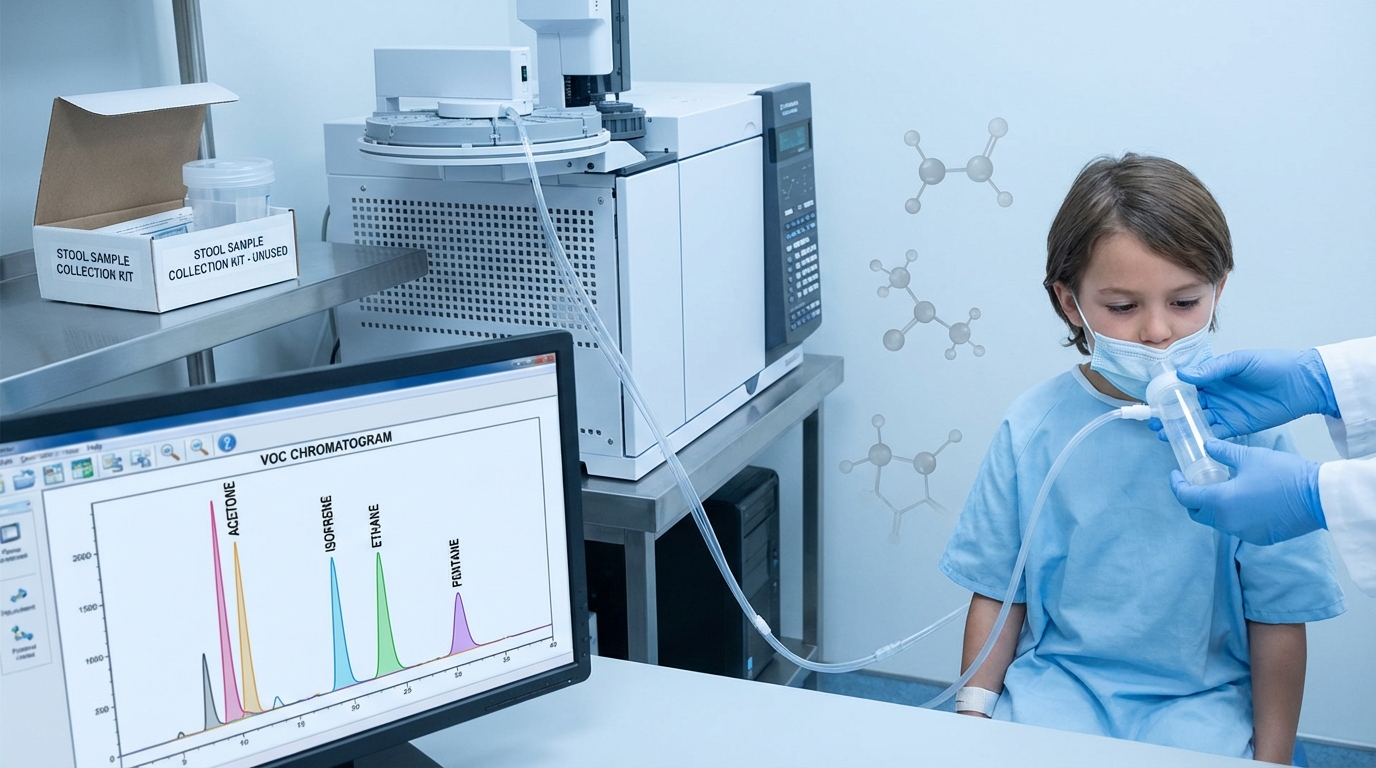
Hernandez-Leyva et al. enrolled 27 healthy children (ages 6 to 12) in the MACK study (Microbiome-Asthma Connection in Kids) and collected matched stool and breath samples from each participant. They then compared shotgun metagenomic sequencing of the gut microbiome against breath VOC profiles measured by GC-qTOFMS.
The correlations were stronger than most would expect from a proof-of-concept study. Breath volatilome profiles tracked gut microbial taxonomy (r = 0.74, p = 0.023), gene cluster composition (r = 0.79, p = 0.011), and metabolic pathways (r = 0.71, p = 0.03). Of 37 curated VOCs analyzed in depth, 35 had more than 20% of their variance explained by microbiota composition.
In plain terms, the chemical signature in a child's breath reflected what was happening in their gut with surprising fidelity.
Mouse Models Confirmed the Causal Link
To rule out confounding variables, the team validated their findings in gnotobiotic mouse models. Mice colonized with different microbial communities produced distinct breath VOC signatures (PERMANOVA R² = 0.222, p = 0.0024). In monocolonization experiments with five individual bacterial species, including Akkermansia muciniphila and Bacteroides thetaiotaomicron, specific VOCs detected in bacterial culture headspace also appeared in the monocolonized mice's breath.
The takeaway is straightforward. Specific gut bacteria produce specific volatile metabolites, and those metabolites show up in exhaled air. This is not just correlation. The causal chain from gut microbe to breath signal has at least preliminary mechanistic support.
Why Labs Should Care
The scientific finding is interesting on its own. The operational implication is what matters for clinical laboratories.
Stool collection kits are a known pain point in microbiome diagnostics. Patients dislike them. Compliance rates are inconsistent. Shipping logistics add cost and turnaround time. Stool samples also require careful handling to preserve microbial DNA integrity, which limits how far the workflow can scale.
Breath collection, by contrast, is noninvasive, fast, and generates a sample that can be processed on-site. If breath VOC profiling can be validated as a reliable proxy for gut microbiome status, it would remove the single biggest operational barrier to scaling microbiome diagnostics in clinical settings.
The Caveats Are Real
This was a proof-of-concept study with 27 pediatric participants, not a clinical validation trial. The team acknowledges that correlation strength would need to hold across larger, more diverse populations before breath VOCs could serve a diagnostic function.
Several practical barriers remain. Analytical standardization for breath VOC measurement is still evolving. Regulatory pathways for breath-based microbiome diagnostics do not exist yet. Reimbursement frameworks for this type of test are entirely undefined.
The study also focused on healthy children with a secondary analysis of asthma. Whether breath VOC profiles maintain their predictive value across different disease states, age groups, and clinical contexts is an open question.
Connecting the Dots: Oral Microbiome Research Tools
Breath-based diagnostics sit at the intersection of gut and oral microbiome research. VOCs in exhaled air reflect microbial metabolic activity across the entire aerodigestive tract, not just the gut. That makes oral fluid matrices directly relevant for labs developing or validating breath-adjacent microbiome assays.
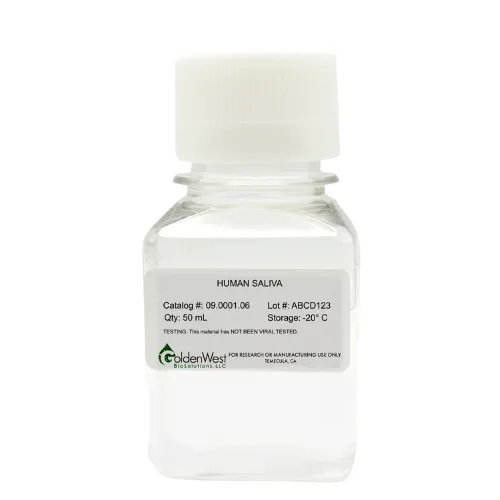
For labs building analytical workflows around oral or gut microbiome metabolites, key applications include:
- Oral microbiome profiling: Characterizing microbial communities that contribute to VOC production across the aerodigestive tract.
- Salivary biomarker validation: Identifying metabolic markers that overlap with breath VOC signatures in clinical cohorts.
- Point-of-care assay development: Calibrating diagnostic platforms that bridge oral fluid sampling and breath-based testing methods.
What Comes Next
The path from proof-of-concept to clinical utility is long. The team will need larger cohorts, disease-specific validation, and head-to-head comparisons with existing stool-based methods. Analytical reproducibility across instruments and collection protocols will be critical.
But the fundamental observation, that gut microbiome composition leaves a measurable chemical fingerprint in exhaled breath, is now supported by both human and animal data with credible statistical backing. For labs watching the microbiome diagnostics space, this is worth tracking. The work does not change clinical workflows today, but it suggests the specimen collection problem may eventually be solvable.
References
- Hernandez-Leyva AJ, Berna AZ, Bui MH, et al. The gut microbiota shapes the human and murine breath volatilome. Cell Metabolism. 2026. DOI: 10.1016/j.cmet.2025.12.013.
- Washington University School of Medicine. Breath carries clues to gut microbiome health. WashU Medicine News. January 22, 2026. Link.
- The Scientist. A breath of air could help diagnose gut microbiome disruptions. January 23, 2026. Link.
- Dark Daily. Study: Breath test could transform microbiome diagnostics for clinical labs. March 30, 2026.
Have questions about this research or our products?
Contact Our TeamGet new posts delivered to your inbox