Cold Chain Is Becoming Healthcare Infrastructure: What GEODIS' Chicago Expansion Signals
Apr 26, 2026
GEODIS opened a 78,000 sq ft dedicated healthcare cold-chain cross-dock near O'Hare on April 22. The facility is small relative to its parent network but signals a shift in how pharma supply chains are being built around certified transfer points rather than packaging alone.
On April 22, 2026, GEODIS opened the first dedicated healthcare cold-chain cross-dock facility in the Americas. The site sits in Chicago near O'Hare International Airport. It runs 78,000 square feet as a Container Freight Station and bonded facility, with a newly built 5,200 square foot healthcare addition. Inside that addition, 4,600 square feet hold controlled ambient cargo at 15 to 25°C and 600 square feet hold refrigerated cargo at 2 to 8°C. The branch is a Certified Cargo Screening Facility and is IATA CEIV Pharma certified. It supports biologics, vaccines, specialty pharmaceuticals, and other temperature-sensitive products moving through air and ocean import and export lanes (Pharmaceutical Commerce; GEODIS).
The square footage is modest. The placement, certifications, and timing matter more.

The market context
Introspective Market Research valued the global cold chain pharmaceuticals market at $19.41 billion in 2024 and projects it to reach $31.02 billion by 2035, a 4.82% CAGR. The same report identifies biologics, biosimilars, and advanced therapy medicinal products as central growth drivers, since these products are structurally temperature-sensitive (Introspective Market Research).
Most of that growth comes from higher-value, lower-tolerance products. A pallet of stable ambient cargo and a shipment of cell therapy do not carry the same stakes if something goes wrong in transit. As biologic and specialty drugs take a larger share of pharma revenue, the cost of a temperature excursion rises with it.
Why Chicago
O'Hare is one of the largest air cargo gateways in the world. The Chicago Department of Aviation reports the airport processes more than two million metric tonnes of cargo per year worth over $200 billion, and ranks first by freight value among airports in the Americas. It serves more than 25 cargo carriers from Asia, Europe, and the Americas, with about two million square feet of airside cargo facilities and another two million landside (FlyChicago).
For healthcare logistics, that scale also means concentration. International air freight, customs activity, ground distribution, freight forwarders, integrators, and rail all converge in one market. Cold chain risk concentrates at exactly those convergence points: documentation handoffs, modal transfers, dwell time at customs, and movement between facilities not all built to healthcare standards. Putting a certified, temperature-controlled facility next to a hub like O'Hare addresses that geography directly.
What cross-docking buys you in healthcare
Cross-docking moves freight from inbound to outbound transportation with minimal storage in between. UPS Healthcare describes the model as a way to reduce storage requirements and shorten delivery timelines, with specific value for vaccines, biologics, and specialty medications, where reduced handling and reduced transit time help maintain required conditions (UPS Healthcare).
For ordinary freight, that is mostly a velocity story. For healthcare, it is also a control story. A dedicated healthcare cross-dock provides a controlled environment for the segment of the journey that is most exposed: temperature is held within defined zones, documentation moves with the shipment, and custody changes are recorded inside facilities built to handle pharmaceutical cargo. The product clears the transfer step without being absorbed into general freight assumptions.
What CEIV Pharma certification means
IATA's CEIV Pharma program certifies that a facility, its equipment, its operations, and its staff meet pharmaceutical industry expectations for cold-chain transport. It addresses an old problem in air cargo: inconsistent standards across shippers, forwarders, handlers, carriers, and airports. GEODIS describes its CEIV Pharma certification as ensuring its facilities, equipment, operations, and staff comply with the standards, guidelines, and regulations expected by pharmaceutical manufacturers (IATA).
Certification does not eliminate risk on its own. It does not replace supplier qualification, lane validation, or excursion management. What it does is set a baseline that buyers can verify, which makes vendor selection more comparable and reduces the gap between what quality teams require and what freight operations can deliver.
What to ask cold-chain partners
For pharma, biotech, diagnostics, and biostorage buyers, the GEODIS announcement is a useful reminder to evaluate networks at the points where risk concentrates. Beyond the standard questions about temperature range, packaging, and quoted transit time, the more useful questions for high-value lanes are:
- Where are the transfer-heavy points in this lane, and what facilities handle the cargo at each?
- Is the customs and bonded dwell time spent in healthcare-dedicated environments or general cargo space?
- Which facilities along the route hold CEIV Pharma certification?
- How are temperature data, custody records, and excursion alerts moved with the shipment?
- What is the escalation path during a temperature excursion or customs delay?
- Can controlled ambient, refrigerated, frozen, ultra-low, or cryogenic conditions be matched to the actual stability profile of the product, not just the standard 2 to 8°C bucket?
Vaccine storage guidance from CDC reinforces why these questions matter. Vaccine refrigerators are required to maintain 2 to 8°C, and temperature excursions can affect potency and usability rather than just paperwork (CDC Pink Book). Cell and gene therapies push the requirement further, often into ultra-low or cryogenic ranges, with chain-of-identity and chain-of-custody tracking through packaging, shipping, storage, and patient use (Cell & Gene).
The same logic inside the lab
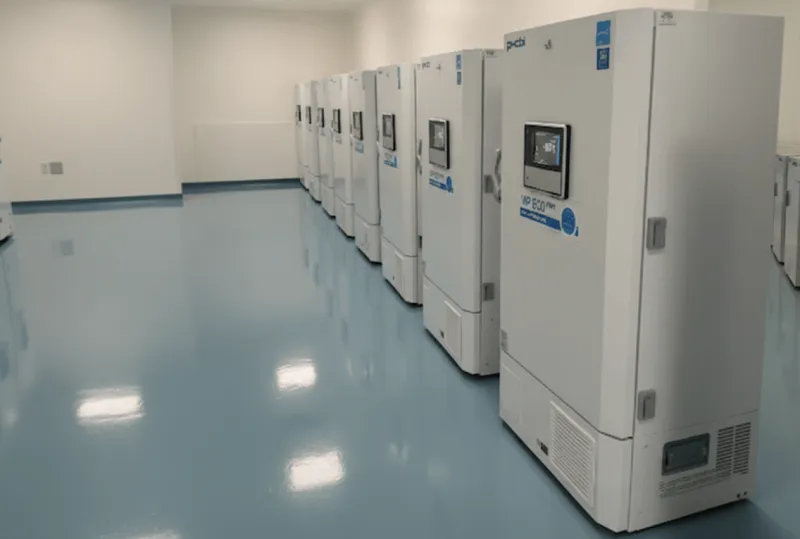
The control disciplines that make a healthcare cross-dock work are the same ones that govern in-lab biospecimen storage: defined temperature zones, validated equipment, continuous monitoring, documented chain of custody, and qualified handling. Once a sample, biospecimen, or therapeutic lot reaches its storage destination, that infrastructure determines whether it remains usable.
The takeaway
GEODIS' Chicago facility is a small piece of a large network, but it reflects where pharma logistics is going. Buyers are evaluating cold-chain partners less on transit lanes and more on the certified control points that protect product as custody changes hands. For high-value biologics, vaccines, and specialty therapies, that infrastructure is becoming a procurement requirement rather than a competitive advantage.
References
- Appezzato, S. (2026). Amid Growing Cold Chain Demand, GEODIS Opens First Dedicated Healthcare Cross-Dock Facility in Chicago. Pharmaceutical Commerce, Apr. 22, 2026. pharmaceuticalcommerce.com
- GEODIS. (2026). GEODIS Unveils First Cold Chain Cross-Dock Facility in the Americas. Apr. 22, 2026. geodis.com
- Kumbhar, T. (2026). Cold Chain Pharmaceuticals Market is Projected to Reach USD 31.02 Billion by 2035. Introspective Market Research, Jan. 2026. introspectivemarketresearch.com
- Chicago Department of Aviation. O'Hare Cargo. FlyChicago. flychicago.com
- IATA. CEIV Pharma. iata.org
- UPS Healthcare. (2025). Faster, Safer Cold Chain Logistics with Cross-Docking. Aug. 27, 2025. ups.com
- Cell & Gene. Cell & Gene Therapy Cold Chain: Ensuring Product Integrity. cellandgene.com
- CDC. Chapter 5: Vaccine Storage and Handling. Pink Book. cdc.gov
Have questions about this research or our products?
Contact Our TeamGet new posts delivered to your inbox